Ecommerce SEO services in Pune
Ecommerce SEO services in Pune, for stores we build and for stores that reach us already live. We do not stop when your store goes live. We build it with search foundations in place, then work on its organic visibility for the next twelve months.
Category and product optimisation, technical monitoring, content clusters, internal linking, Merchant Center and monthly reporting, all against a scope you can read.
Rankings are not for sale and we will not promise them. The work, the standards, the monitoring and the reporting are what we commit to.
- Foundations during the buildArchitecture, templates, canonicals, tracking
- Category and product optimisationThe pages that actually earn ecommerce revenue
- Content clusters and internal linksBuying guides, comparisons, use cases
- Merchant Center and product feedsFree listings where your products are eligible
- Reporting against revenue, not rankingsMonthly report, quarterly strategy review
Most disappointment starts with this distinction
An agency says SEO is included, the client hears twelve months of growth work, and the invoice covered a sitemap. We separate the two in writing before anything is signed, and where you want both from one team that is an ecommerce website with SEO.
SEO foundations
Included in every store we build, because a site that cannot be crawled or measured is not finished.
- Keyword-informed category and URL structure
- Crawlable navigation, breadcrumbs, canonicals
- Editable titles, descriptions and headings
- Sitemap, robots, redirect handling
- Product, organisation and breadcrumb structured data
- Search Console, GA4 and ecommerce events
- Mobile and Core Web Vitals consideration
What foundations are not: a year of keyword tracking, content, product optimisation, feed management or reporting.
Ongoing ecommerce SEO
Billed monthly across twelve months, with a defined scope and a report you can hold us to.
- Continuous keyword and competitor research
- Category, collection and product optimisation
- Technical monitoring and issue resolution
- Content production and page refreshes
- Merchant Center and feed management
- Authority development and outreach
- Monthly reporting and quarterly strategy review
Priced separately from development, so you can see what you are paying for and stop or renew at twelve months.
Six situations this service is built for
The store launched and nothing happened
A site went live with no keyword work behind its categories and no plan after launch. Traffic is branded and direct only.
Every sale is paid for
Ads work, but the moment spend stops so do the orders. There is no organic base underneath the campaigns.
Thousands of products, none of them found
Thin product pages, duplicated descriptions, filters generating endless URLs, and category pages with nothing on them but a grid.
Products keep getting disapproved
A Merchant Center account full of diagnostics nobody reads, missing identifiers, and prices that disagree with the website.
Traffic dropped after a redesign
URLs changed without a redirect map, or a migration went ahead with no indexation plan. Recovery work is a specific job.
Reports arrive but nothing changes
A monthly PDF of ranking positions with no work log, no revenue view and no plan for the following month.
The work, in the order it matters for a Pune store
Category and collection SEO
The highest-value pages in most stores and usually the emptiest. We give them a reason to rank and a reason to convert.
- Hierarchy and collection structure mapped to real demand
- Useful category copy, not a paragraph of keywords
- Filter and facet rules so indexes do not bloat
- Pagination, sorting and canonical decisions
- Internal links from guides into commercial pages
Product page SEO
Every product page, priority items first. The catalogue size sets the price rather than the scope, so nothing is left out to fit a package.
- Titles and descriptions written for buyers and search
- Specifications, FAQs and genuinely useful detail
- Variant, out-of-stock and discontinued handling
- Duplicate description cleanup
- Related product and cross-link blocks
Technical SEO
Monitored monthly rather than audited once. Because we hold the codebase, most findings are fixed in the same cycle.
- Crawl, index and status-code monitoring
- JavaScript rendering checks on headless builds
- Core Web Vitals and image performance
- Redirect chains, broken links, duplicate content
- Structured data validation
Content clusters
Written in-house by people who understand the products, then linked deliberately into the pages that sell.
- Buying guides and category explainers
- Comparison and alternative content
- Use-case and problem-solving articles
- Refreshes of pages that already have impressions
- One pillar, one related guide, one commercial link
Authority development
Relevance over volume. We will not sell you a package of links, and placement fees are always quoted separately.
- Business and ecommerce citations
- Supplier, partner and client mentions
- Relevant outreach and digital PR
- Original research, tools and calculators
- Founder interviews and industry resources
Conversion support
Traffic that does not buy is a cost. We watch what organic visitors do once they land and recommend changes.
- Ecommerce event tracking and funnel views
- Landing page and product page observations
- Checkout friction and mobile navigation review
- Internal search and filter testing
- Development changes estimated separately
Setup and product feed optimisation
Eligible free product listings can appear across Google Search, the Shopping tab, Images, Maps and other Google surfaces. That makes Merchant Center part of organic visibility, not advertising.
It is also not a directory listing. The work is account and website verification, feed configuration, product data quality, shipping and return settings, then diagnostics and disapproval fixes every month. Taken on its own it is our Google Merchant Center setup service.
Included in the Growth and Custom Commerce packages. Available as a standalone add-on if your store was built elsewhere.
Where it fits, and where it does not
- Physical products sold online with real prices and stock
- Not suited to a service business or a catalogue with no checkout
- Approval depends on your policies and product category, so we cannot guarantee it
- Shopping Ads management and ad spend are a separate service
- Accurate business identity and contact details
- Real prices, stock and product identifiers
- A secure checkout
- Shipping information and a return policy covering window, method and fees
- Products and claims that meet Google policy
You can see the whole year before you sign
This is our standard operating model. Yours gets adjusted around your catalogue, seasonality and how much of the site we are also building. On a store that is being rebuilt at the same time, the first months look different and are set out under ecommerce redesign and migration.
Research before anything is built
The cheapest time to fix an information architecture is before it exists.
- Business, product and audience discovery
- Competitor research and existing-site audit
- Keyword research and clustering
- Category, collection and product taxonomy
- Filter and faceted navigation decisions
- Platform recommendation with reasons
- Analytics and conversion requirements
- Merchant Center eligibility review
- SEO risk review for any migration
Measurement and indexation
Nothing else is worth doing until we can see what is happening.
- Verify Search Console and GA4
- Configure ecommerce conversion events
- Confirm sitemap and robots behaviour
- Validate canonicals and test structured data
- Check indexable category and product templates
- Establish keyword and page baseline
- Review mobile experience and Core Web Vitals
- Resolve critical crawl and indexation problems
Commercial pages first
The pages closest to money get worked on before the blog.
- Optimise homepage and primary category pages
- Titles, descriptions, headings, copy, internal links
- Map primary and secondary keywords to pages
- Add commercial FAQs where they help
- Review image naming and alt text
- Begin product-page optimisation to scope
First content cluster
Content exists to support commercial pages, not to fill a calendar.
- Publish the first supporting cluster
- Connect commercial pages and articles deliberately
- Add decision guides, comparisons and use cases
- Review Search Console for early opportunities
- Improve pages with impressions but poor clicks
Merchant Center and product data
Where eligible, free listings are the cheapest incremental visibility available.
- Complete account and website verification
- Configure or validate the product feed
- Review identifiers and required attributes
- Configure shipping and return information
- Enable eligible free listings
- Resolve product diagnostics
- Align website price and availability with the feed
Category and product depth
The second wave, informed by what the first three months revealed.
- Optimise the next set of category pages
- Improve product titles and descriptions in scope
- Add specifications, FAQs and related links
- Review duplicate product content
- Strengthen links between guides, categories and products
First strategic review
Six months in we compare against baseline and change the plan if needed.
- Compare performance with the baseline
- Review rankings and traffic by cluster
- Review organic revenue and assisted conversions
- Identify content gaps
- Review technical health
- Review Merchant Center clicks and diagnostics
- Update the next six-month plan
Authority and high-opportunity content
Pages sitting at positions 8 to 15 are usually the fastest wins available.
- Refresh pages close to page one
- Publish against Search Console opportunities
- Create original tools, comparisons or data assets
- Conduct outreach or digital PR where there is something worth pitching
- Strengthen important category pages
- Add new case studies or proof
Conversion and experience review
Traffic that does not convert is a cost, so this month looks at behaviour.
- Analyse organic landing-page behaviour
- Review mobile navigation and product clarity
- Review checkout friction
- Improve calls to action
- Test internal search and filters
- Recommend development changes
Technical and content refresh
A second full audit, because catalogues and codebases drift.
- Repeat the technical audit
- Review index bloat and faceted navigation
- Repair broken internal links and redirect chains
- Update old prices, statistics and policy information
- Consolidate overlapping content
- Improve underperformers with real demand
Seasonal and commercial planning
Seasonal pages need to exist and be indexed before demand arrives.
- Prepare seasonal pages early
- Improve category content before demand peaks
- Update feeds and promotion data
- Review inventory and out-of-stock handling
- Plan next-year product and category expansion
Annual review and what next
A full accounting, then a proposal you are free to decline.
- Compare full-year KPIs with baseline
- Review organic leads, sales and revenue
- Identify winning keyword clusters
- Document technical work and content assets
- Review Merchant Center health
- Present renewal priorities
- Propose the next twelve-month plan
Measured against revenue, not ranking screenshots
A monthly report with what we did, what we found, what it moved and what happens next. A quarterly session to change direction if the data says so.
Demand and visibility
- Non-branded impressions and clicks
- Branded versus non-branded split
- Keyword cluster movement
- Valid indexed pages
Commercial outcomes
- Organic add to cart and checkout starts
- Organic purchases and revenue
- Assisted conversions
- Category and product page performance
Merchant Center health
- Approved products versus submitted
- Free listing clicks
- Open diagnostics and disapprovals
- Price and availability mismatches
Work and accountability
- Work completed against scope
- Technical issues found and resolved
- Content published and refreshed
- Next month plan and what we need from you
Three ways to buy this
Development is quoted per project, against the drivers in what ecommerce website development costs in Pune. The twelve months of SEO is billed monthly or quarterly, separately, so the cost of growth work is never hidden inside a build price.
Store Launch
A properly built store with search foundations, for businesses not ready for an ongoing engagement.
- Shopify or WooCommerce build
- Product and category setup, up to 100 products listed
- Payments and shipping integrated
- Technical SEO foundations
- Search Console, GA4, launch index check
- No monthly SEO, content or reporting
- No Merchant Center monitoring
Ecommerce Growth, 12 months
The store, then a structured first year of organic growth work with the same team.
- Everything in Store Launch
- Full keyword research, clustering and page mapping
- Every category page and every product page optimised
- Five to eight articles a month, with two rounds of revisions
- Merchant Center setup with the whole catalogue submitted, plus feed and diagnostics
- Forty development hours a month for fixes and improvements
- Technical monitoring and Search Console analysis
- Monthly report and quarterly strategy review
Custom Commerce Growth, 12 months
For custom workflows, integrations or performance architecture, with the same twelve months of growth work.
- Discovery and technical architecture
- Next.js storefront with a named commerce backend
- Headless Shopify, headless WooCommerce, Django or Node
- ERP, inventory, CRM, dealer or marketplace integrations
- Rendering and indexation controls for JavaScript builds
- Twelve months of ongoing SEO
- Priority support to contract
The twelve months ends rather than rolls over. We re-quote against what the catalogue looks like by then, and you decide, there is no notice period to remember and no automatic renewal.
Next.js does not rank higher than WordPress
One more thing worth saying plainly: Next.js is a storefront framework, not an ecommerce admin. A real solution also needs a commerce backend for products, orders, inventory and customers, which is why a headless build is two systems rather than one. We name the whole architecture in the proposal.
Some agencies sell a framework as a ranking advantage. Google does not reward a site for being built in Next.js. Rankings come from crawlability, indexation, content, structure, page experience and authority.
WooCommerce development is the practical choice for a standard store that needs flexible content management and a lower initial investment. A custom ecommerce build on Next.js suits businesses needing advanced workflows, integrations, performance control or headless architecture. Both can be built with strong SEO.
| Requirement | WooCommerce | Next.js custom |
|---|---|---|
| Initial investment | Lower | Higher |
| Launch speed | Usually faster | Usually longer |
| Content management | Familiar and convenient | Needs a CMS or admin layer |
| Standard online store | Strong fit | Often unnecessary |
| Custom workflows | Possible, can get plugin-heavy | Strong fit |
| Performance control | Good with care | Greater architectural control |
| Ongoing maintenance | Partly manageable in-house | Needs development support |
| SEO capability | Excellent | Excellent |
Proof, once we have permission to show it
An SEO page with no evidence is just claims. The first is a real Search Console export, anonymised. The two after it are still reserved, and stay empty until there is something real to put in them.
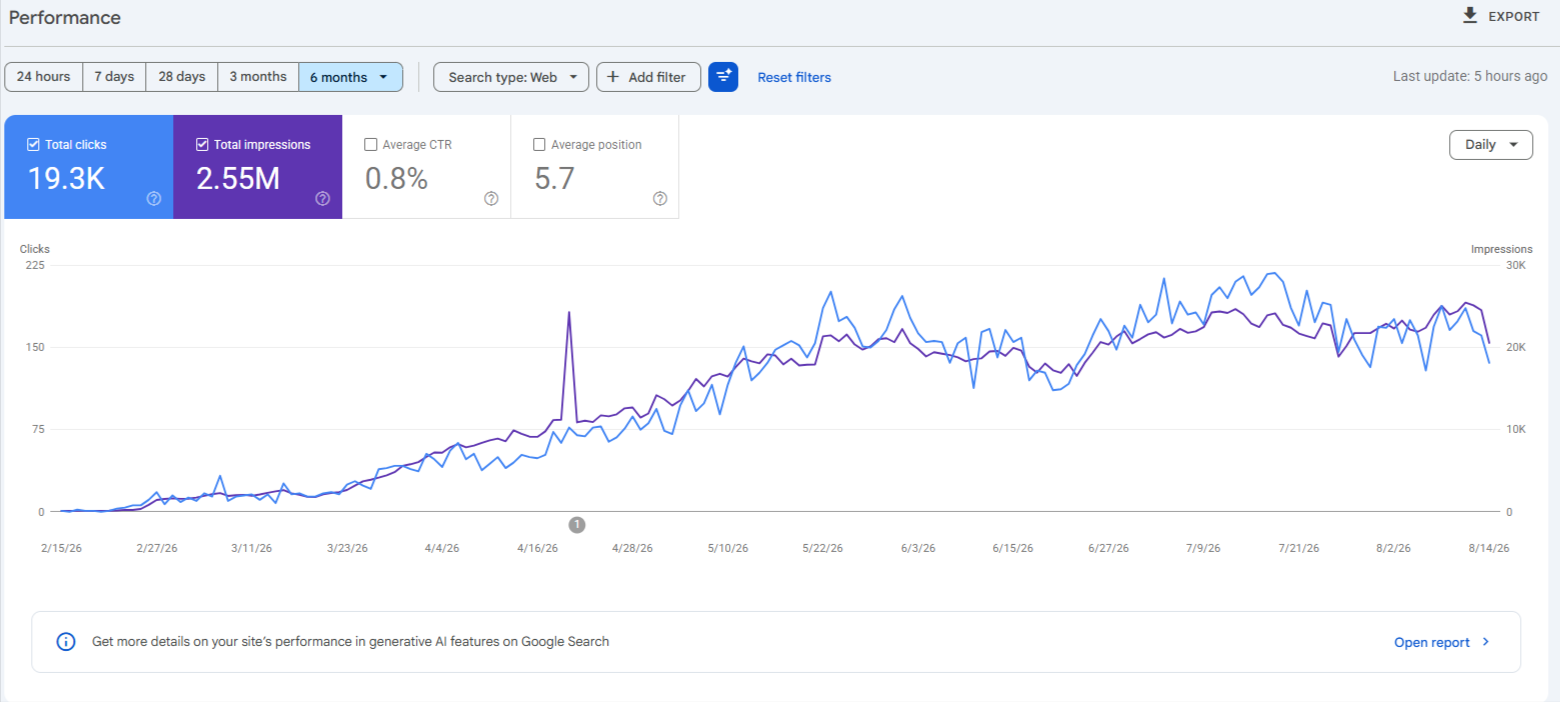 (opens the full-size export in a new tab)
 Six months of growth on a store we run this on
Clicks and impressions, 15 February to 14 August 2026, from a near-zero baseline: 19.3K clicks, 2.55M impressions, average position 5.7. The store is not named because we do not publish a client without written permission.
A store made measurably faster
Field data at the 75th percentile, not a single lab score on a fast connection.
Disapprovals cleared on a live catalogue
Approved versus submitted products, and which attribute caused each failure.
What we will not promise you
Anyone who promises the things on this list is either guessing or lying. We would rather lose the enquiry than win it dishonestly.
First position on Google, or any fixed ranking date
A fixed traffic increase or a fixed number of sales
Merchant Center approval regardless of your compliance
Visibility for every product you submit
Guaranteed backlinks, or unlimited anything
That technical SEO alone will produce rankings
The questions that decide it
Ask anything else on WhatsApp. You will get a straight answer from someone who does the work.
How long before we see results?
Long-tail and product queries often move within the first few months. Competitive category terms usually take longer, and a brand new domain takes longer again. We report impressions and cluster movement from month one so you can see direction before revenue arrives, and we will not attach a date to a position. Any ecommerce SEO agency that gives you one is guessing.
Can you do SEO on a store you did not build?
Yes, and it is a large part of the work. We start with an audit of architecture, indexation, templates and tracking . If the platform or the build has structural problems we will tell you honestly whether optimisation is worth it or whether a rebuild is the cheaper path over two years.
Why twelve months and not month to month?
Because the plan only makes sense as a sequence. Measurement and technical work come first, then commercial pages, then content clusters, then Merchant Center and product depth, then refreshes of whatever is close to page one. Stopping at month three means paying for the setup and none of the compounding. At twelve months you decide whether to renew.
Do you optimise every product?
No, and nobody should claim to. We agree a number of product pages for the year and work through them by commercial priority, starting with the products that already get impressions or carry the best margin. Template-level improvements benefit the whole catalogue, and the remaining pages can be added as extra scope.
Is Google Shopping advertising included?
No. We handle Merchant Center setup, product data and free listings , which are organic surfaces. Paid Shopping campaign management and the ad spend itself are a separate service with separate pricing, and we will say so in the proposal rather than blur the line.
What do you need from us each month?
Access to Search Console, analytics, the site and the feed. Approvals on content within five working days. Accurate prices, stock and policies. A heads up before you change products, platform or the site. Product knowledge when we are writing about something technical. Delays on these move the timeline rather than compress the work.
Do you buy links?
We do citations, client and partner mentions, relevant outreach, digital PR and original assets worth linking to. We do not sell link packages or promise a number of placements. Where a publication charges a fee, that cost is yours to approve and is quoted separately, never buried in the retainer.
What happens after twelve months?
We present the full-year comparison against baseline, the clusters that worked, the technical work log and the content assets built. Then we propose the next twelve months as a new agreement. Nothing renews automatically, and everything we made stays yours either way. If the twelve months showed that the site itself is the ceiling , we will say that too.
Send us the store and what you sell
We will look at your architecture, indexation, category structure and feed, then come back with the three things worth doing first. No obligation, and no automated audit PDF.
hello@ecommercepune.in
We will look at the store properly before replying, so expect a real answer rather than a template. If it is urgent, call or WhatsApp +91 88620 92781 .